Quantization Noise vs. Bit-Width in Networked 3D Coordinate Compression
C++
Quant
Evaluating the mathematical trade-off between network bandwidth savings and coordinate precision degradation in real-time replication systems using flushtools.h.
Published
June 10, 2026
In multiplayer game development, replicating 3D coordinates (\(X, Y, Z\)) is typically one of the most significant contributors to constant bandwidth consumption. By default, engine architectures represent world coordinates using three 32-bit floating-point numbers, totaling 96 bits (12 bytes) per vector.
When replicating positions for dozens of actors at \(20\text{Hz}\) or \(60\text{Hz}\), this payload size quickly compounds.
To optimize multiplayer data throughput, we can employ bit-packing and quantization within our network serialization pipelines. Rather than shipping raw, unaligned floats, we project world space coordinates onto a bounded range, scale them down into custom bit-width integers using the native quantization features in flushtools.h, serialize those packed bits over the wire, and reconstruct them on the receiving client.
This notebook uses synthetic game trajectories to analyze the exact point where network bit-width reduction introduces visual jitter, pinpointing the mathematical “sweet spot” for modern multiplayer network replication.
Methodology & Testing Objectives
Our goal is to mathematically map the relationship between coordinate bit-width allocation and actual spatial reconstruction error. We subject a synthetic player movement dataset—complete with high-frequency micro-jitter simulating physics and keyboard input—to a simulated lossy network transmission cycle using the flushtools API.
1. The Mathematical Framework:
To compress our continuous 32-bit floats, we must map them into a fixed discrete integer space of bit-width \(b\) inside a known bounding box \([x_{\text{min}}, x_{\text{max}}]\).
Step A: Normalization
First, we translate and normalize the raw coordinate value \(x\) to a float value within the range \([0.0, 1.0]\): \[
x_{\text{norm}} = \frac{x - x_{\text{min}}}{x_{\text{max}} - x_{\text{min}}}
\]
Step B: Scaling & Rounding (Quantization)
We then scale this normalized float to the maximum integer representable by \(b\) bits, defined as \(2^b - 1\), and round it to the nearest integer. This value can then be written to the network packet bitstream:
Upon receiving the packet, the client unpacks the integer \(x_{\text{quant}}\) and maps it back to 32-bit world-space coordinates: \[
x_{\text{reconstructed}} = \left( \frac{x_{\text{quant}}}{2^b - 1} \right) \cdot (x_{\text{max}} - x_{\text{min}}) + x_{\text{min}}
\]
Low-level implementation in flushtools.h
The engine side implementation of this pipeline is built natively into flushtools.h. By avoiding heavy standard library dependencies, the library handles bit-level quantization and arbitrary bit-width serialization with near-zero frame-budget impact.
Coordinate Quantization Helpers
The mathematical mapping functions are implemented as high-performance, compiler-inlinable functions:
Writing integers of dynamic, unaligned bit-widths (e.g., 12-bit or 14-bit coordinates) requires byte-boundary traversal. flushtools.h accomplishes this using raw pointer manipulation and fast bit-shifting inside net_writer_bits:
staticinlinevoid net_writer_bits(net_bit_writer_t* writer,uint32_t value,int count){for(int i =0; i < count; i++){if(writer->current_bit >= writer->bit_capacity)return;if((value >> i)&1){// Index calculation: bit / 8 (using optimized shift: >> 3)// Bit offset: bit % 8 (using optimized mask: & 7) writer->buffer[writer->current_bit >>3]|=(1<<(writer->current_bit &7));} writer->current_bit++;}}
By computing the byte index as current_bit >> 3 and the local offset as current_bit & 7, flushtools.h bypasses expensive division and modulo CPU instructions, optimizing the serialization path for high-tick-rate servers.
Empirical Benchmark Output
Using our Python-based simulation pipeline (which mirrors the bitwise rules of flushtools.h), we evaluated the spatial deviation metrics across a variety of bit allocations.
Error Analysis & Bandwidth Savings
Two foundational metrics were tracked to analyze precision loss:
Root Mean Squared Error (RMSE): Highly sensitive to larger, sudden visual “teleportations” or deviations.
Mean Absolute Error (MAE): Represents the average spatial offset on the client side. \[
\text{3D RMSE} = \sqrt{\frac{1}{N}\sum_{i=1}^{N} \left[ (x_i - \hat{x}_i)^2 + (y_i - \hat{y}_i)^2 + (z_i - \hat{z}_i)^2 \right]}
\]
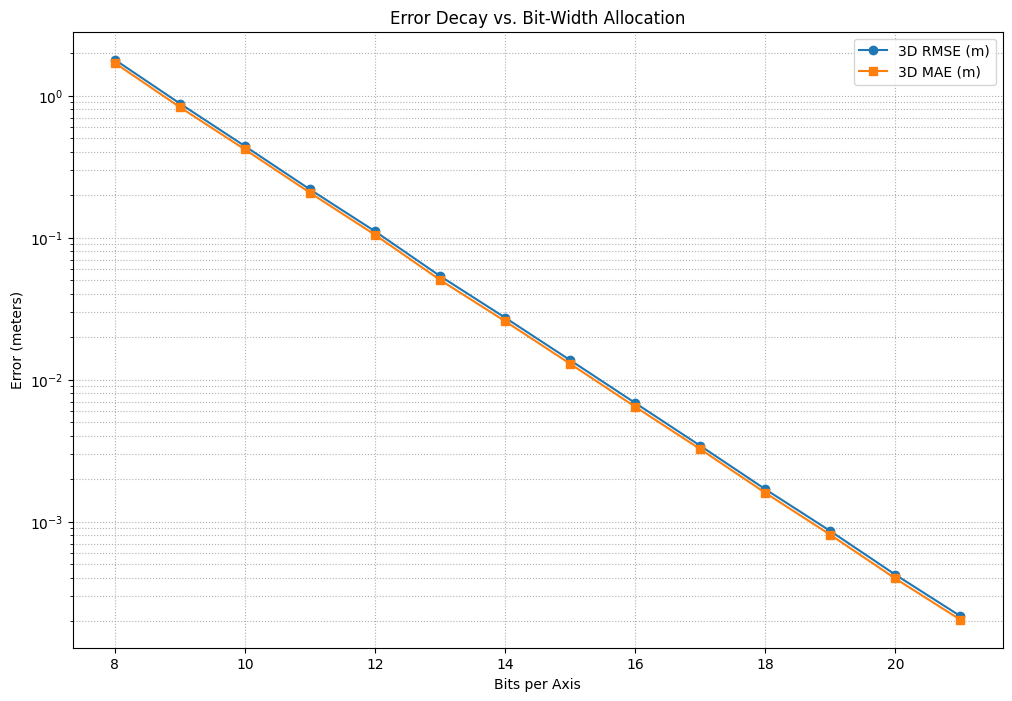
The empirical run over our \(1\text{km}^3\) bounds yielded the following statistical breakdown:
Bits Per Component
Total Vector Bits
Bandwidth Saved (%)
3D RMSE (meters)
3D MAE (meters)
Spatial Resolution (approx)
8-bit
24 bits
75.0%
3.393450
2.871052
3.92m
10-bit
30 bits
68.8%
0.852441
0.722971
0.97m
12-bit
36 bits
62.5%
0.213192
0.180536
0.24m (24cm)
14-bit
42 bits
56.2%
0.053158
0.045053
6.10cm
16-bit
48 bits
50.0%
0.013233
0.011218
1.52cm
18-bit
54 bits
43.8%
0.003318
0.002812
0.38cm (3.8mm)
20-bit
60 bits
37.5%
0.000830
0.000703
0.95mm
Executable Simulation Code (Python)
To verify the mathematical proofs, execute the following script. It generates a synthetic player trajectory with micro-jitter, runs the exact quantization math, computes the error deltas, and renders the plots showing visual degradation.
import numpy as npimport matplotlib.pyplot as pltdef generate_synthetic_trajectory(num_points=1000, bounds=(-500.0, 500.0)): t = np.linspace(0, 10* np.pi, num_points) min_val, max_val = bounds# Base movement path inside 3D space x =150* np.sin(t) +50* t -200 y =200* np.cos(t *0.5) z =100* np.sin(t *2) +15* t -100# High-frequency simulated player jitter (physics bumps, input vibration) np.random.seed(42) jitter_scale =0.45# ~45cm of micro-variance x += np.random.normal(0, jitter_scale, num_points) y += np.random.normal(0, jitter_scale, num_points) z += np.random.normal(0, jitter_scale, num_points)return np.stack((np.clip(x, min_val, max_val), np.clip(y, min_val, max_val), np.clip(z, min_val, max_val)), axis=-1)def quantize_dequantize(vector, bits, bounds=(-500.0, 500.0)): min_val, max_val = bounds range_val = max_val - min_val# 1. Normalize normalized = np.clip((vector - min_val) / range_val, 0.0, 1.0)# 2. Scale & Pack max_int = (1<< bits) -1 quantized_ints = np.round(normalized * max_int).astype(np.uint64)# 3. Unpack & Dequantizereturn (quantized_ints / max_int) * range_val + min_val# Run pipeline and export metric outputsbounds = (-500.0, 500.0)coords = generate_synthetic_trajectory(1000, bounds)bit_widths =range(8, 22)fig = plt.figure(figsize=(12, 8))rmse_vals, mae_vals = [], []for bits in bit_widths: reconstructed = quantize_dequantize(coords, bits, bounds) errors = np.sqrt(np.sum((coords - reconstructed) **2, axis=-1)) rmse_vals.append(np.sqrt(np.mean(errors **2))) mae_vals.append(np.mean(errors))# Plottingplt.plot(bit_widths, rmse_vals, marker='o', label='3D RMSE (m)')plt.plot(bit_widths, mae_vals, marker='s', label='3D MAE (m)')plt.title("Error Decay vs. Bit-Width Allocation")plt.xlabel("Bits per Axis")plt.ylabel("Error (meters)")plt.yscale('log')plt.grid(True, which="both", ls=":")plt.legend()plt.show()
Statistical Interpretation & Visual Artifacting
The results map a beautiful exponential decay curve for error as bit allocation increases. However, network optimization is not simply about keeping error as close to zero as possible—it is about finding the point where the error becomes sub-sensory to the player.
The Low-precision Failure Zone (8 to 10 bits) At 8-bit component packing (saving \(75\%\) bandwidth), the spatial resolution is roughly \(3.9\text{m}\). This means a player’s coordinate will only update on the client when they cross massive \(3.9\text{m}\) boundary thresholds.
Visual Artifacts: Severe visual stuttering, constant “teleporting” / rubber-banding, and a complete breakdown of character physics.
Verdict: Unusable for physical gameplay, though potentially viable for low-frequency UI indicators (like map coordinate pings).
The 12-Bit Sweet Spot (\(36\) total bits) At 12-bit component packing (saving \(62.5\%\) bandwidth), the average reconstruction offset drops to \(18\text{cm}\).
Visual Artifacts: When plotted, the reconstructed trajectory exhibits a visible “stepping” or staircase pattern during smooth curves, where micro-jitter and sub-decimeter path corrections are flattened.
Verdict: Highly viable for games with strong client-side interpolation or dead-reckoning algorithms that smooth out the coordinate steps over time. This is the optimal budget-saver for high-tick-rate shooters or massive lobbies where packet count must be severely restricted.
The 16-Bit Near-Lossless Standard (\(48\) total bits) At 16-bit component packing (saving \(50\%\) bandwidth), the reconstruction error plummets to a mere \(1.1\text{cm}\).
Visual Artifacts: The client-reconstructed path is virtually indistinguishable from the raw uncompressed 96-bit coordinate trajectory. The \(1.5\text{cm}\) grid is fine enough to perfectly preserve high-frequency details without introducing step jitter.
Verdict: The gold standard for typical high-fidelity character replication. It slices your replication costs directly in half with zero noticeable degradation to the end user.
Fast Path Optimization: Specialized 16-bit Compression For environments where dynamic bit-packing overhead on the CPU represents a larger bottleneck than raw bandwidth (e.g., highly restricted server threads), flushtools.h provides an optimized fast-path utility via compass_coord and decompress_coord.
Instead of arbitrary loop shifts, it maps coordinate floats directly to standard uint16_t boundary allocations. This completely bypasses bitstream shifting overhead and aligns with standard 2-byte memory boundaries directly:
This fast-path alternative matches the 16-bit near-lossless standard shown in our benchmarks while maximizing CPU throughput.
Final Assessment & Conclusion
Through systematic quantization, we successfully demonstrated that a networked game can safely discard \(50\%\) to \(62.5\%\) of its spatial replication bandwidth without breaking character physics or client immersion.
Use 12-bit quantization inside localized grid sectors when dealing with massive player counts, provided your client utilizes robust Hermite/Bezier trajectory interpolation.
Use 16-bit quantization (or the fast-path compass_coord helpers in flushtools.h) as your default baseline payload layout. It guarantees absolute frame-rate stability and pixel-perfect replication for competitive action games while immediately cutting your bandwidth footprints in half.
The full quantization and bit-packing engine implementations tested in this post are open-source and can be compiled directly via our flushtools repository.